INSIGHTS / AI & PLAYER ANALYTICS
Player Digital Twins: Simulating Behavior Before Launching a New Feature
By Evgenii Polubabkin · Originally published on LinkedIn on .
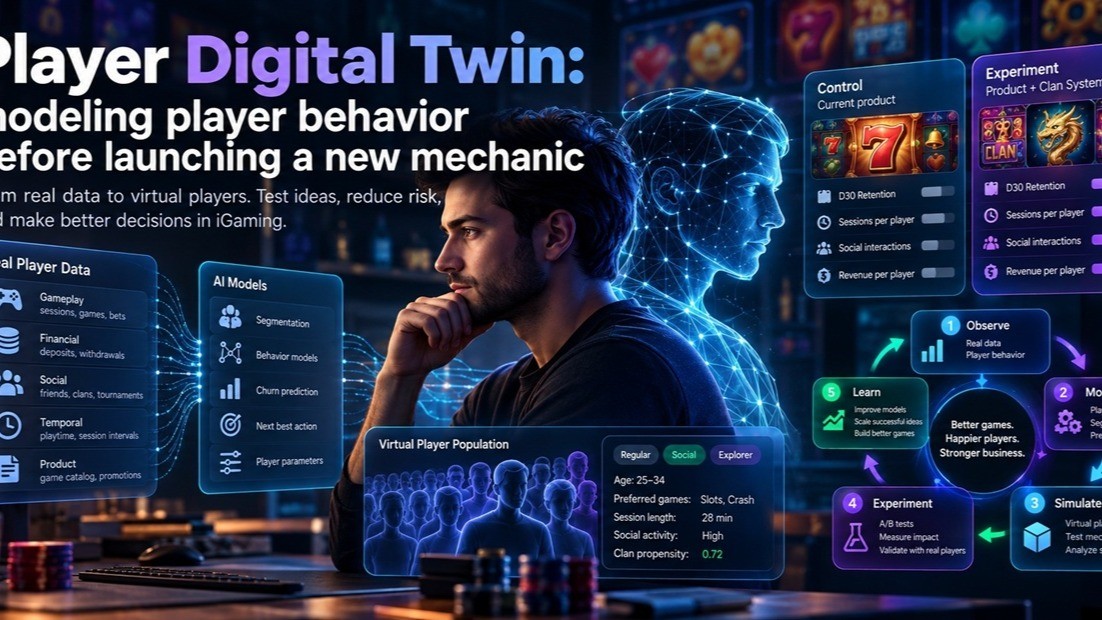
Imagine a typical situation in iGaming product development.
A Product Manager proposes a new mechanic — for example, clans, team tournaments, or shared goals. The idea looks promising: it should boost social engagement and give players an additional reason to return to the product.
But to test the hypothesis, a long journey is required:
Idea → Game Design → Development → Integration → QA → Production → A/B Test → Data Collection → Analysis
After several months, the team finally gets an answer: the mechanic does affect retention — or virtually nothing has changed.
But what if a significant portion of hypotheses could be tested before full-scale development begins?
This is where an interesting concept emerges — the Digital Twin of a player.
What Is a Player Digital Twin?
In industry, a Digital Twin is a digital model of a physical object that allows simulating its state and response to changes.
A similar approach could be tried for a gaming product.
But it's important to make a caveat right away.
The Digital Twin of a player is not an attempt to create a perfect digital copy of a specific person, nor is it "an AI that knows what the user will do."
It is far more practically useful to think of a Digital Twin as a probabilistic model of the behavior of an individual player or a player cohort Conventionally, built on historical data.
For example, we know that a certain group of users:
· plays about three times a week;
· prefers slots and crash games;
· spends about 25–30 minutes per session in the product;
· periodically tries new games;
· actively participates in tournaments;
· has several friends within the platform.
Based on historical data, we can model the probabilities of the following actions for such a player:
Will they open the product tomorrow?
Which game will they choose?
Will they try a new mechanic?
Will they join a clan?
How will their activity change after a team tournament is introduced?
Thus, the Digital Twin does not answer the question:
"What will definitely happen?"
but rather a much more useful question for the Product team:
"What could potentially change under certain assumptions?"
How It Can Work
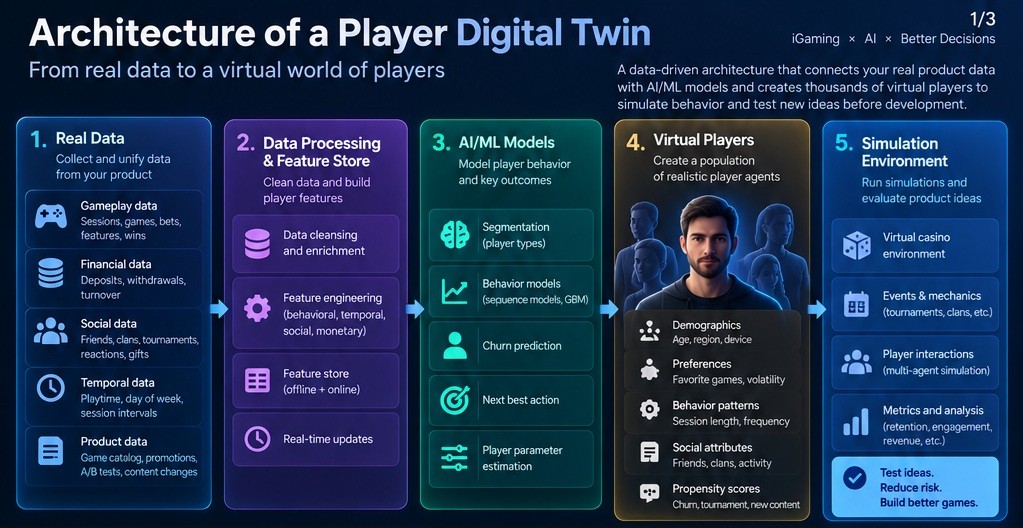
The architecture of such a system starts with the same data already used by product analytics and ML.
For example:
Gameplay Data
Temporal Data
Social Data
Player State
Based on this data, players can be grouped into behavioral segments or described by a set of continuous parameters.
Then a virtual population is created.
For example:
100,000 Player Agents.
Each agent has its own state and probabilistic behavior model.
For illustration:
Player Agent #48291
Regular Player
Plays 3 times/week
Slots + Crash
Average session: 28 min
Social activity: High
Novelty interest: High
Clan propensity: 0.72
Tournament propensity: 0.64
Churn probability: 0.08
And now the most interesting part begins.
Creating a Virtual Casino
We can run the simulation forward in time.
A new day begins.
For each agent, the model determines the probability of:
Open the product?
If yes:
Which game?
Then:
How long will the session last?
Try new content?
Participate in social activity?
After the virtual day ends, the agent's state is updated.
And the process repeats.
Day after day.
As a result, we can obtain a simulation of the virtual population's behavior over a horizon of 30, 60, or 90 days.
Now Let's Add a New Mechanic
Suppose the team is considering developing a Clan System.
Normally, you would first need to develop the system, release it to a portion of the audience, and run an A/B test.
A player digital twin could add an intermediate step.
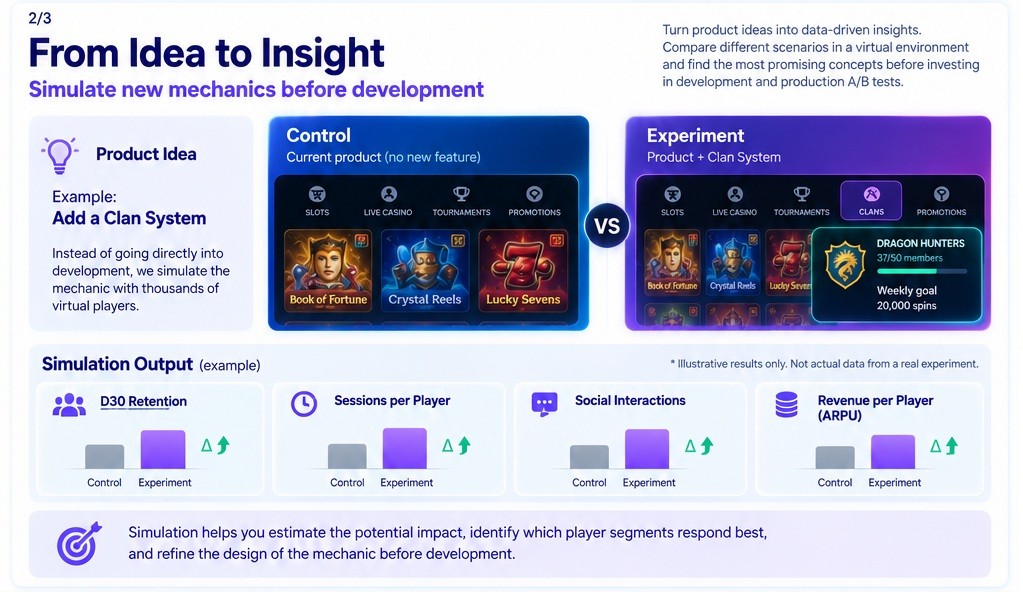
We create two virtual worlds.
Control
100,000 agents interact with the existing product.
Experiment
The same virtual population gets access to the Clan System.
Within the experimental world, new actions appear:
Join Clan
Invite Friend
Contribute to a clan goal
Clan Tournament
Social Reaction
Return because of Clan Event
After that, we simulate, for example, 90 days.
And compare the scenarios.
We might be interested in:
D7 / D30 retention
Sessions per Player
Average Session Duration
Game Diversity
Social Interactions
Clan Participation
Tournament Participation
Churn Probability
Moreover, it's not just the average effect that matters.
Perhaps the Clan System barely changes anything for the entire audience, but strongly affects a specific behavioral segment.
This already gives the Product team much more information for designing a future A/B test.
But There's a Serious Trap
An LLM can generate convincing user-like behavior.
This does not at all mean that it actually reproduces the behavior of a real user.
Therefore, you cannot build the system as follows:
LLM → Synthetic Players → Business Decision
Calibration is required:
Real Players → Behavioral Data → Model Calibration → Digital Twin → Simulation
After new production data arrives, the model is recalibrated.
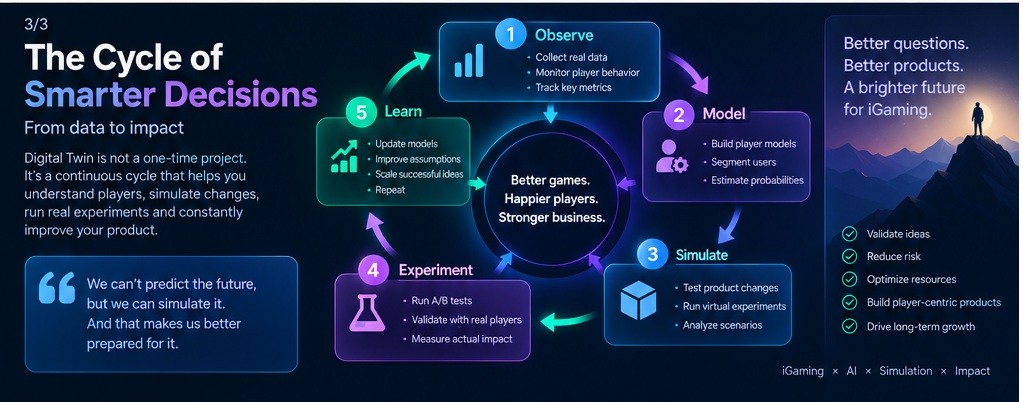
This results in a continuous cycle:
Observe → Model → Simulate → Experiment → Measure → Learn
In my opinion, this cycle is much more interesting than the very idea of a "virtual player."
From Analytics of the Past to Simulation of the Future
Most modern analytics systems answer the question perfectly well:
"What happened?"
BI shows metrics.
Product Analytics shows funnels.
ML can answer:
"What is likely to happen to the current user?"
For example, Churn Prediction estimates the probability of churn.
Digital Twin adds a third level:
"What could potentially happen if we change the product?"
This creates an interesting evolution:
Analytics → Prediction → Simulation
It is precisely this last level that can significantly change the process of developing gaming products.
Not because AI will be able to accurately predict the future.
But because teams will be able to reduce the cost of testing ideas that may fail.
Test more hypotheses.
Find weak ideas earlier.
Better understand different player segments.
And go to production with better-informed experiments.
In iGaming, where developing a new mechanic can take months, and the consequences of a product decision become clear only after accumulating a sufficient volume of data, this is a potentially very powerful tool.
Key Takeaway
Digital Twin is not a digital prophet. It's an experimental environment. A good Digital Twin should not tell a Product Manager:
"Here's what will happen."
It should help ask much more useful questions:
"Under what conditions will this work?"
"For which players?"
"Which assumptions have the greatest impact on the outcome?"
"What will happen if our assumptions are wrong?"
And perhaps the ability to answer such questions will become one of the most interesting applications of AI in gaming product development in the coming years.
#iGaming #ArtificialIntelligence #GameDevelopment #ProductManagement #DigitalTwin #MachineLearning #GameAnalytics #Simulation #PlayerExperience